










+20% forklift operator productivity thanks to task combination and intelligent sequencing
Case study — Normandise Group & Skipper Group / SVR
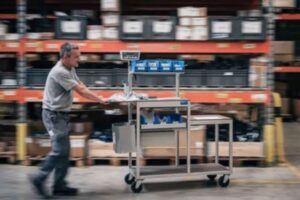
In a warehouse with high traffic flow and tight dock constraints, every forklift operator's movement counts. Handling tasks one by one, without an overall view, means accepting empty runs and limited productivity.
The Guided Mission and Sequencer are game changers, transforming every movement into a productive opportunity.
Guided Mission: Combine missions to eliminate empty trips
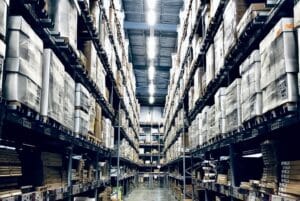
The Normandise group operates a 25,000 m² narrow-aisle platform at the exit of an agri-food factory. The flows are extremely dense: around fifty truck equivalents entering and the same number leaving, to supply the platforms of major retailers in Europe.
In this context, Guided Mission deploys mission combination functions that radically change productivity:
- Storage/retrieval chaining : a storage action is combined with a pallet retrieval action based on the operator's position via triangulation.
- Aisle prioritization : the system directs the forklift operator to the aisles with the maximum number of combined tasks, then to the next aisle once the current aisle is completed.
- Emergency management : ability to dynamically switch between a highly productive mode (missions combined by aisle) and a reactive mode (missions combined by order to expedite urgent loading)
Result: it is possible to exceed 40 pallets/hour per forklift operator thanks to this triangulation, this combination of missions and this optimized choice of aisles.

A control tower for the warehouse manager
The Guided Mission provides the warehouse manager with a complete control tower to manage their resources in real time:
- Task allocation : dedicate some operators to productive tasks (combined missions) and others to emergencies (maximum responsiveness)
- Dynamic switching : moving from a productive mode to a reactive mode depending on the order status and the lead time on the workload
- Team organization : depending on the workload intensity, organize teams in production mode, mixed mode, or emergency response mode.
Sequencer: orchestrate launches to smooth the load
Alongside the Guided Mission, the Sequencer organizes the creation of missions according to constrained resources.
Normandise Case Study — Dock Sequencing: When traffic is very heavy, launching all orders simultaneously saturates the docks. The Sequencer synchronizes launches based on dock availability : when a driver leaves, the system identifies the next order to be prepared according to the pickup schedule and automatically pushes it forward. Result: a smoother workload without disrupting operations.
SVR Skipper Case Study — Consolidation Sequencing: When an order combines full pallets, full cartons, and mixed cartons, the Sequencer chains the orders together. It first releases the pallets of full cartons, then releases the mixed cartons once the pallets are ready. This consolidation within the flow avoids subsequent consolidation and eliminates time-consuming operations.
The Sequencer also anticipates replenishment of pickings potentially several days in advance, so that stocks are available at the time of preparation.

The Guided Mission + Sequencer combination offers complete control over mission workflows, from prioritizing emergencies and smoothing workloads to optimizing every movement. This productivity and flexibility lever transforms operational management.
You don't want to wait?
Let's discuss your logistics challenges
A SITACI expert analyzes your context and identifies your performance levers.
REQUEST AN EXPERT DIAGNOSIS →