













AGV vs AMR: Understanding the difference in 3 minutes
Logistics
4.0 solutions
Supply Chain
July 9, 2026
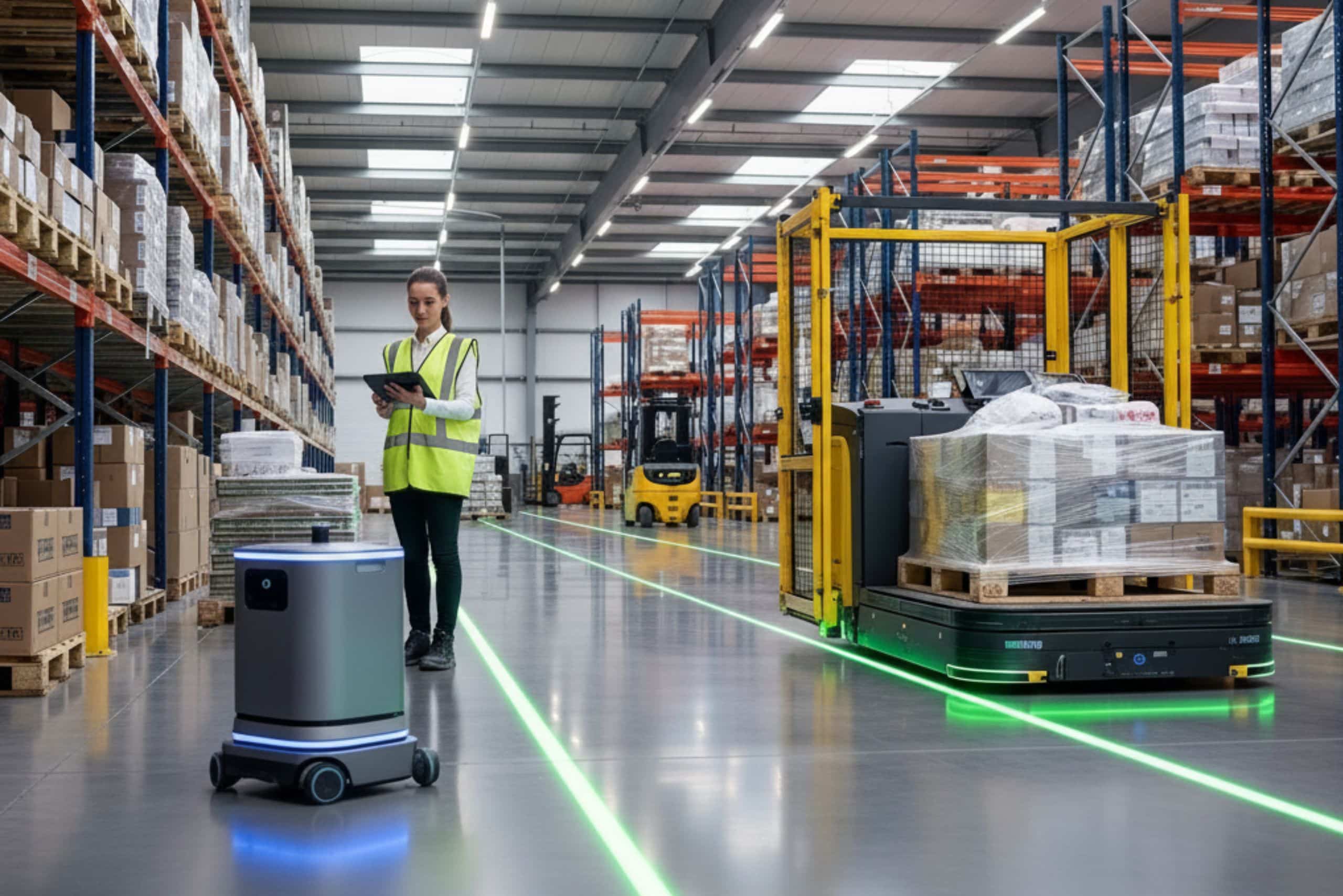
Faced with the explosion of e-commerce and the labor shortage, mobile robots have become essential in many warehouses. But between AGVs and AMRs, two philosophies clash:
- Two different approaches : The AGV follows a fixed and predefined path (reliable but rigid). The AMR navigates freely thanks to AI, adapting in real time to its environment.
- A key economic trade-off : AGVs are cheaper to purchase but often require significant infrastructure work. AMRs are quicker to install and adapt to changes in the warehouse.
- The WMS, the indispensable brain : without integration with your Warehouse Management System, no fleet of robots can deliver its full value.
The real question, therefore, is not "AGV or AMR?" but "which technology, or combination, best suits my workflow?" This article provides the keys to making the decision: data comparisons, a decision grid, and essential questions.
The pressure on warehouses has never been greater. Explosion of e-commerce, demand for ever-faster deliveries, labor shortages… Every day is a new challenge.
In this race for performance, automation is no longer an option, but a necessity. And at the heart of this revolution are mobile robots.
The market is full of models and technologies, but they are not all created equal. The question then arises: should we opt for AGV (Automated Guided Vehicle) robots, the pioneers of automation, or for AMR (Autonomous Mobile Robots), their intelligent and agile successors?
This decision could radically transform your logistics flows. It will impact your productivity, your flexibility and, ultimately, your profitability.
So, how do you make the right choice? This article will guide you step by step so that you can select the technology that will truly propel your warehouse.
A deep dive into mobile robotics: Two philosophies, two technologies
Before comparing them, you need to understand what fundamentally defines an AGV and an AMR. Although they both serve to automate the transport of goods, their approach to navigation and interaction with their environment is radically different.
AGVs (Automated Guided Vehicles): Structured Reliability
AGVs are the elders of intralogistics. Appearing in the 1950s, they are designed for a simple and essential task: to follow a predefined path with unwavering reliability.
Imagine a train on its tracks. It cannot deviate from its path. The AGV works on the same principle. Its navigation is wire-guided, meaning it follows physical lines (magnetic strips, cables embedded in the ground) or virtual paths defined by laser reflectors.
Their main mission: transporting heavy loads over fixed and repetitive distances. They are tireless as long as their route is clear.
Their intelligence is limited: if an obstacle appears in their path, they stop and wait for it to be removed. They cannot take initiative. This simplicity is both their strength—proven reliability and safety—and their greatest weakness.
Autonomous Mobile Robots (AMRs): Intelligence and Flexibility
AMRs represent a major technological leap. They are the result of progress in artificial intelligence, computer vision, and advanced sensors.
If the AGV is a train, the AMR is an autonomous car. It doesn't need rails. It maps its environment using technologies like SLAM (Simultaneous Localization and Mapping) – the same one used by robot vacuum cleaners – and navigates dynamically.
Thanks to its sensors (LiDAR, 3D cameras, security scanners), the AMR "sees" and "understands" its environment in real time. It can identify obstacles, whether fixed (a rack) or mobile (an operator, an order picking cart), and bypass them by instantly recalculating the best route.
This adaptability makes it theideal tool for complex and changing environments, typical of e-commerce warehouses where order preparation is intense and flows are unpredictable. They are designed to collaborate safely with humans.
AGV vs AMR at a glance
| Criteria | AGV | AMR |
|---|---|---|
| Navigation | Wire-guided (magnetic strips, cables, laser reflectors) | Autonomous (SLAM, LiDAR, 3D cameras) |
| Flexibility of the route | Fixed, expensive modification | Dynamic, reconfigurable in just a few clicks |
| Obstacle management | Stops and waits | Detour and recalculate the route |
| Deployment time | Several weeks to months (infrastructure work) | A few hours to days (software mapping) |
| Interaction with humans | Limited, passive safety (stop) | Collaborative, proactive safety (trajectory anticipation) |
| Typical payload | High (up to several tons depending on the model) | Variable, generally lighter (up to 1.5T for the majority of models on the market) |
| Unit acquisition cost | Weaker | Higher |
| Infrastructure costs | Elevated (ground markings, cabling) | Almost nothing |
| Ideal for | Stable, repetitive flows, heavy loads | Dynamic flows, picking, changing environments |
The battle of the technologies: AGV vs AMR, a detailed comparison to help you make the right choice
The choice between these two technologies should be guided by a precise analysis of your needs, your environment and your long-term objectives.
Navigation and flexibility: Agility versus rigidity
This is the most discriminating criterion.
AGV robots offer virtually no flexibility . Their path is set in stone (or rather, in the warehouse floor). Modifying a route involves construction work, a work stoppage, and significant costs. A single box falling onto their track is enough to paralyze part of the flow. This rigidity is incompatible with operations that require constant adaptation .
AMR robots , on the other hand, embody flexibility . Their initial deployment involves a "mapping" phase where the robot traverses the warehouse to create a digital map. Once this map is saved, the fleet management system can dynamically assign them tasks. If the warehouse layout changes, a simple map update is all it takes. When faced with an obstacle, they don't stop; they find a way around it. This agility enables much better real-time management of logistics flows and ensures business continuity .
Installation and deployment: Weeks of work versus a few hours of configuration
Deploying a fleet ofAGVs is an infrastructure project. Magnetic strips, cables, and laser reflectors must be installed. This can take several weeks or even months and often requires disrupting operations in the affected area.
Deploying AMRs is radically simpler and faster. SLAM technology allows robots to map the warehouse in just a few hours, often without disrupting ongoing operations. Installation is therefore primarily software-based. This rapid implementation is a significant advantage for companies that cannot afford lengthy downtime.
Costs and economic model: Initial investment vs. Total Cost of Ownership (TCO)
At first glance, an AGV robot is often cheaper to buy than an AMR robot with more complex technologies. However, this view is misleading.
The true cost of an AGV project includes the purchase of the vehicles AND the very high cost of installation and modification of the warehouse infrastructure. Each subsequent modification to the route will generate additional costs.
While more expensive per unit, AMRs require virtually no infrastructure costs. Investment is concentrated on the onboard technology. Their flexibility also eliminates the costs associated with future reconfigurations. In the long term, within a dynamic environment, the total cost of ownership (TCO) of an AMR fleet is often more advantageous.
Safety and Human-Machine Collaboration
Both technologies are safe. AGVs have basic safety scanners that instruct them to stop if an obstacle is detected. They are safe, but not very collaborative.
AMRs, on the other hand, are designed for interaction. Their 360° sensors and onboard intelligence allow them not only to detect a human, but also to anticipate their trajectory and smoothly avoid them by slowing down or going around them, without necessarily coming to a complete stop. This creates a more harmonious and productive work environment where humans and machines collaborate.
Use case: Each robot has its own mission
The choice will ultimately depend on the tasks you wish to automate.
Ideal use cases for AGVs:
- Pallet transport: Transfer of heavy and standardized loads between fixed points (e.g., from the end of the production line to the storage area).
- Repetitive processes: Tasks that never change, in a stable and predictable environment.
- Environments with low human interaction.
Ideal use cases for AMRs:
- Order picking: This is their area of expertise. Goods-to-Man systems, where automated guided vehicles (AGRs) bring shelves directly to operators, have become the standard for efficiency. They drastically reduce the movement of order pickers.
- Picking replenishment: Transport of pallets from the stockroom to the picking aisles.
- Sorting and shipping: Moving sorted packages to the corresponding shipping docks.
- Dynamic environments: E-commerce warehouses, 3PL, where product references (SKUs) and layout change frequently.
Decision table: Which technology should you choose based on your profile?
| Criteria | AGV | AMR |
|---|---|---|
| CAPEX (capital expenditure) | High cost : robots + infrastructure (marking, cabling, reflectors). Expect additional costs for non-machine components, often representing 40 to 60% of the total project budget. | Moderate to high : focused on the robot and software, low infrastructure costs |
| OPEX (recurring costs) | Low on stable data flows, but high if frequent reconfiguration (new jobs with each change) | Moderate : software updates, sensor maintenance, etc. |
| Flexibility | Low : 1 path = 1 fixed configuration | High : reconfiguration in a few hours via software |
| WMS Integration | Generally simple but fixed (few dynamic exchanges required, the route being fixed) | More technically complex (real-time API, dynamic orchestration) but richer in added value |
| ROI based on volume processed | Profitable from very high and stable volumes (e.g., +5000 pallets/month on fixed routes in industry) | Profitable even with medium volumes and high variability (e.g., 500 to 2000 orders/day in e-commerce, seasonal peaks) |
| Average ROI time observed | 18 to 36 months | 12 to 24 months, but often less than 12 months in e-commerce and 3PL environments |
| Installation complexity | High : work, partial shutdown of activity, several weeks to months | Low to moderate : software mapping, a few hours to days |
| Use Cases | Pallet transport on stable and repetitive flows (industry, pharmaceuticals, food processing), warehouse shuttles with low variability, areas with predefined traffic and low population density | Order preparation for multi-SKU e-commerce/retail, flows with seasonal peaks, multi-client 3PL warehouses, environments with high density of obstacles and high flow variability |
Integration with your WMS: The brain of your automation operation
Buying a fleet of mobile robots without seamlessly integrating them into your information system is like buying a race car without wheels. The raw performance is there, but you can't control it. In your case, the driver of your warehouse is your Warehouse Management System (WMS).
Why is WMS software the cornerstone of automation?
Your warehouse management system, or WMS, is much more than just inventory management software. It's the brain that drives all your operations. It oversees inventory management, storage management, and, most importantly, it orchestrates order picking.
Yes, it's the WMS platform that receives customer orders, locates products in the warehouse, and determines the most efficient picking order. For a fleet of robots to perform well, it must receive its orders directly from the WMS.
Without integration, you would be forced to manually manage robot missions, thus negating all productivity gains. Good integration allows the WMS to communicate mission orders ("go get product X from location Y and bring it to packing station Z") directly to the robot fleet management system.
This synergy means perfect traceability and optimized logistics flow management.
Checklist for a successful WMS-Robots integration
Integration is a crucial step that should not be overlooked. Here's a roadmap to ensure nothing is forgotten.
- Step 1: Audit your current WMS.
- Does it have open and documented APIs (Application Programming Interfaces) that allow easy communication with third-party systems? An aging or "closed" WMS can make integration complex and costly, or even impossible.
- Step 2: Define the data flows precisely. What information needs to flow between systems? Typically:
- Orders for picking, replenishment, and storage.
- Confirmation of pickup, drop-off,
- Robot status, alerts.
- Step 3: Involve the operational teams. Your order pickers and warehouse managers are best positioned to describe current workflows. Automation should improve their processes, not replace them.
- Step 4: Choose a robot supplier with strong integration expertise. The AMR/AGV manufacturer should be able to demonstrate experience with your type of WMS or, at a minimum, with similar systems. Request case studies.
- Step 5: Plan rigorous testing phases. Don't switch over your entire warehouse at once. Start with a pilot area. Test all possible scenarios: peak activity, error handling, outages, etc.
- Step 6: Train your teams. Operators will need to learn how to interact with the robots and use the new software interfaces. Change management support is essential for buy-in and the project's success.
Calculate the Return on Investment (ROI) of your robot fleet
Investing in mobile robotics is a strategic decision that must be justified by ROI calculations.
Costs to consider
For a proper analysis, it is necessary to include all direct and indirect costs:
- Acquisition cost: The price of the mobile robots themselves.
- Infrastructure costs (especially for AGVs): Floor markings, reflectors, etc.
- Software cost: Licenses for the fleet management system, and potentially the costs of upgrading or developing your WMS software.
- Integration cost: The budget for professional services that will connect the WMS and the robots.
- Maintenance and support costs: Annual contracts to ensure the proper functioning of the hardware and software.
- Training cost: The time required to train your teams on these new automated inventory management tools.
The gains to be quantified
This is where the investment makes perfect sense:
- Productivity gains: This is the most direct gain. A Goods-to-Man system based on AMR can multiply by 2, 3 or even 6 the number of order lines prepared by an operator per hour, simply by eliminating travel time.
- Reduction of picking errors: Automation drastically reduces human error, which decreases the cost of returns and improves customer satisfaction.
- Improved safety: Less movement of manual equipment such as order picking carts means less risk of accidents.
- Optimizing storage space: Some robotic systems allow for greater storage density, delaying the need to expand the warehouse.
- Flexibility and scalability: It is easy to add robots to the fleet to handle peak activity periods (Black Friday, sales) and remove them during off-peak periods (RaaS model – Robot as a Service).
When to invest? The telltale signs
Are you wondering if now is the right time? Here are some indicators:
- Your order preparation error rate is too high and is costing you dearly.
- You are unable to keep up during seasonal peaks.
- The costs associated with workplace accidents are a concern.
- Your competitors are automating and becoming more efficient.
- You want to make your logistics a competitive advantage by building a true warehouse of the future.
10 questions to ask yourself before investing in a fleet of mobile robots
Such an investment should definitely not be made impulsively. AMR or AGV, each has its strengths. However, these can become weaknesses if they are not combined with the right context and the right workflows.
Take the time to answer these 10 questions honestly. They will save you a lot of trouble.
- Are my logistics flows stable or do they change regularly? If your business changes little (same routes, same volumes), an AGV may suffice. If your flows vary according to seasons, new customers, or SKUs, an AMR will be more suitable.
- What is my daily order/pallet volume? Too low a volume may not justify the investment (see ROI based on volume processed in the decision table above).
- Does my current WMS have open APIs to integrate with a fleet of robots? This is THE technical prerequisite. Without it, any robotics project will be more complex, delayed, and potentially much more expensive.
- Is my warehouse likely to change its layout in the next 3 to 5 years? An expansion project, a relocation or a reorganization strongly argues in favor of AMR.
- If the AGV suits me, do I have the budget to finance infrastructure work? Floor markings, cables, reflectors… All of this represents a significant cost to anticipate in your business plan.
- Are my teams ready to collaborate with robots on a daily basis? Integrating robots changes everyone's habits. Change management is a key point that is far too often underestimated.
- What is my current order preparation error rate and its true cost (returns, after-sales service, customer dissatisfaction)? Quantifying this overall cost will allow you to precisely measure the gain brought about by automation.
- Have I measured the total cost of ownership (TCO) over 5 to 10 years, and not just the purchase price? This is clearly the most common mistake: focusing solely on the initial CAPEX without anticipating the costs of maintenance, reconfiguration and software updates.
- What KPIs should I put in place to measure the success of the project after deployment? Robot availability rate, productivity gain per workstation before/after, error rate before/after…: without KPIs defined upstream, it is impossible to demonstrate the ROI a posteriori to your management.
- Have I planned a pilot phase before a large-scale deployment? Testing on a limited area or a specific flow allows for adjusting parameters, preparing and training teams gradually, and securing the investment before a full rollout.
Building your warehouse of the future: Beyond AGVs and AMRs
The vision of the warehouse of the future is not a binary opposition between AGVs and AMRs, nor a total replacement of humans. It is an intelligent synergy between different technologies and human skills.
The synergy of technologies: The best of both worlds
In very large warehouses, it is entirely possible to have the two technologies coexist. AGVs could be used for mass transport over long straight distances (for example, for replenishment picking), while a fleet of AMRs would handle the more complex and higher value-added tasks in dense picking areas.
The orchestration of this coexistence is ensured by the WMS, which assigns the right task to the right robot. This is where strategies like ABC classification (or abc ranking) become crucial. The WMS, knowing which products have the highest turnover (class A), can organize storage and robot missions to minimize travel distances and maximize efficiency.
The future is collaborative ("Cobotics")
The ultimate goal is not a warehouse without humans, but one where operators perform more high-value tasks thanks to technology. AMRs (Automated Robotic Reproduction) are at the forefront of this "cobotics" (collaborative robotics) trend. They take over the most arduous and repetitive tasks, such as long journeys.
This allows operators to focus on tasks that require their intelligence and dexterity: quality control, complex packaging, and exception handling. The work becomes less physically demanding, safer, and more rewarding.
AGV for structure, AMR for agility: Your warehouse, your choice.
The decision between AGV robots and AMR robots is not simply a technological choice. It is a strategic decision that must be aligned with the nature of your operations, your environment, and your vision for the future.
In summary:
- Opt for AGVs if your flows are stable, standardized, repetitive and you are looking for a proven solution for point-to-point transport of heavy loads in a relatively unchanging environment.
- Consider AMR if your warehouse is dynamic, if you manage a large number of SKUs, if flexibility is your priority, and if you aim for close and secure collaboration between humans and robots, especially for complex tasks.
The success of your project will depend not only on the robot, but also on the intelligence of the ecosystem that controls it. Seamless integration with a high-performance WMS solution is the true engine of your supply chain optimization.
Ready to take your logistics to the next level? Automation is within your reach.
Contact us for a warehouse audit. Together, we will analyze your workflows and determine the mobile robotics solution that perfectly addresses your challenges and transforms your performance.
FAQ: Everything you need to know about mobile robots
Can an AGV be transformed into an AMR?
No, these are two fundamentally different technologies. An AGV is designed to follow predefined lines or paths. An AMR uses advanced sensors and AI to navigate freely. It's not possible to "upgrade" an AGV into an AMR; that would mean completely changing its navigation system, sensors, and control software—essentially building a new robot.
What is the average lifespan of a mobile warehouse robot?
The lifespan of an AGV or AMR is generally several years, often between 7 and 10 years, or even more. This depends on the intensity of its use, the quality of its manufacture and, above all, the rigor of preventive maintenance (checking batteries, sensors, wear parts).
Does the installation of AMR require a complete shutdown of the warehouse?
No, and that's one of their major advantages. Deployment takes place in two stages: mapping, where the robot travels along the aisles to create its map (which can often be done outside of peak hours), and software integration. Regular operations can generally continue with minimal disruption during installation.
Are AMR robots really safe to work alongside humans?
Yes, safety is their priority. AMRs are equipped with multiple sensors (certified security scanners, 3D cameras) that give them a 360° view of their surroundings. They can detect the presence of a person several meters away, anticipate their trajectory, and adjust their speed and path to avoid them smoothly and predictably.
What is the impact of artificial intelligence (AI) on the performance of AMRs?
AI is at the heart of AMR's superiority. It plays a role at several levels:
- Navigation (SLAM): AI allows the robot to precisely locate itself and understand the geometry of the warehouse.
- Obstacle avoidance: AI algorithms analyze sensor data in real time to make the best avoidance decisions.
- Fleet optimization: The system uses AI to distribute tasks between robots in the most efficient way possible, minimizing empty trips and preventing congestion.
Can AGVs and AMRs be used in the same warehouse?
Yes, it's even an increasingly common practice in large warehouses. AGVs handle stable and heavy flows (long-distance mass transport), while AMRs manage dynamic tasks (picking, replenishment).
What is the average budget to start a robotics project with AMRs?
The budget varies considerably depending on the number of robots, the complexity of the warehouse, and the desired level of integration with the WMS. Many providers now offer a RaaS (Robot as a Service) model with a monthly subscription rather than an outright purchase, allowing for a lower initial investment.
Do we need to change our WMS to integrate a fleet of mobile robots?
Not necessarily, but it depends on the technical openness of your current WMS. If your WMS has the right APIs, integration is usually possible without replacing it. However, an outdated or "closed" WMS may require migration to a more suitable solution to fully leverage automation. A preliminary technical audit is strongly recommended.