



















Warehouse automation: our guide to understand everything
Logistics
4.0 solutions
Supply Chain
July 18, 2025
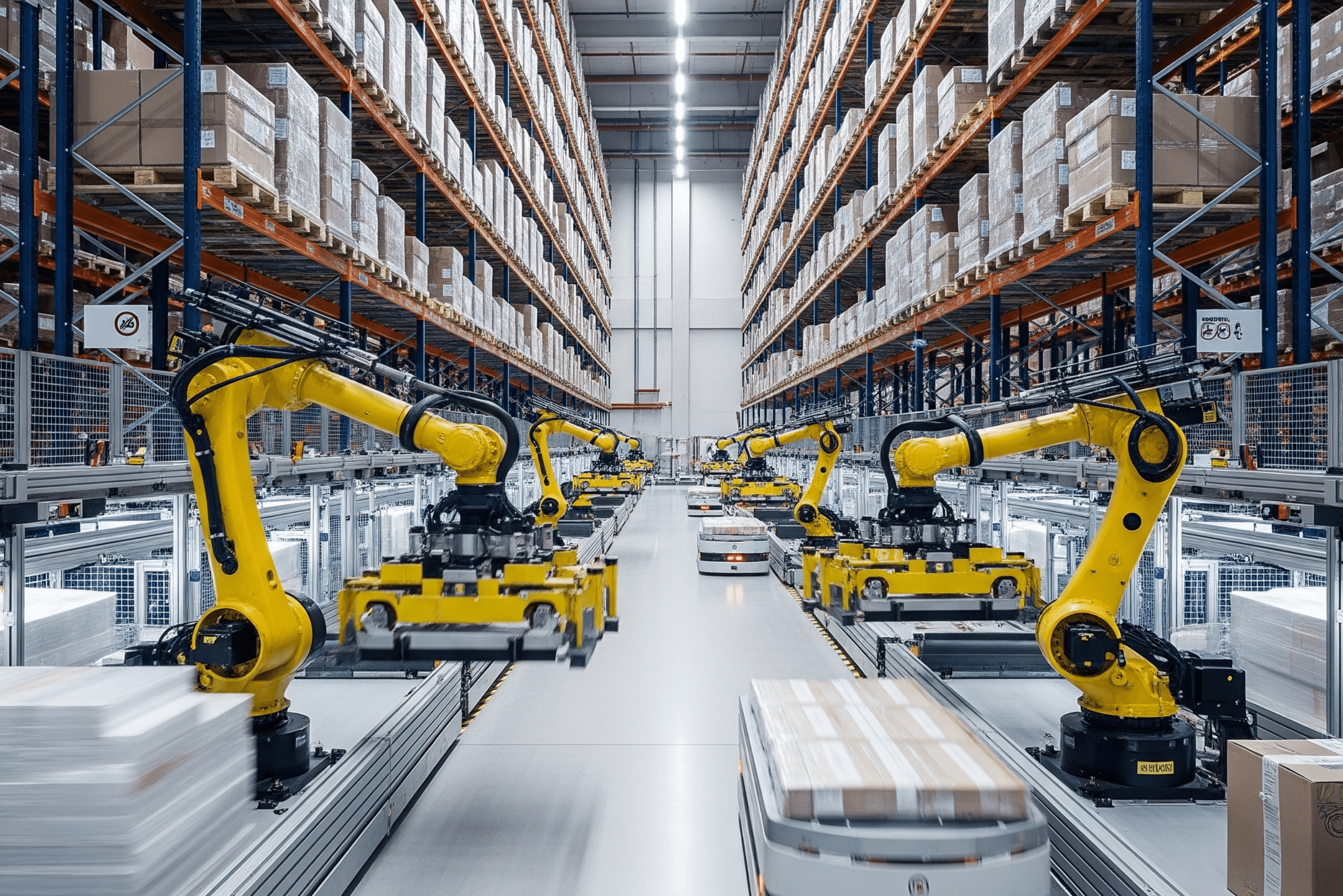
Over time, warehouse automation has become a strategic necessity.
Faced with the explosion of e-commerce, pressure on delivery times, and labor shortages, companies must fundamentally rethink their logistics organization. And at the heart of this transformation: automation.
But what does this really mean? Which technologies should be prioritized? How can a WMS solution help you? How does it fit into this transformation?
The warehouse of the future is already here.
Why automate your warehouse?
Error and cost reduction
Human errors in order preparation are costly. Very costly.
According to Blogistics, a picking error results in an average cost of around €20 per order , mainly due to reverse logistics (returns flow), dispute management, and restocking. Multiply that by hundreds or thousands of monthly shipments, and you get a financial black hole.
Automation is, above all, about reliability.
Thanks to robotics, picking errors have dropped drastically. Repetitive tasks are thus taken over by automated systems, freeing up operators for higher value-added tasks.
Improved productivity
It's no secret that a robot doesn't get tired.
Goods to Man solutions, such as those offered by Exotec or AutoStore, bring the bins directly to the operator.
The result : less travel, less time wasted, and a significantly higher order processing rate.
Optimization of storage space
In a 4.0 warehouse , every square meter counts and costs.
Automated systems allow for storage density up to four times greater than that of a traditional warehouse. Bins are stacked with millimeter precision, leaving no unnecessary empty space.
Automation in urban areas, where square meters are expensive, is a real advantage.
Resilience in the face of unforeseen events
Health crises, seasonal activity peaks, unforeseen absences…
Automation makes warehouses more resilient to various challenges. Furthermore, thanks to integrated technological solutions such as a WMS and autonomous robots, you minimize operational disruptions.
Actionable checklist: Should you automate your warehouse?
- Analyze your current error rates in preparation
- Evaluate the costs of non-quality related to logistics
- Identify time-consuming, repetitive tasks
- Analyze your inventory turnover rate
- Measure your current performance (OTIF, productivity/hour)
- Calculate the potential ROI of automation
Key automation technologies
1. Goods-to-Man Systems
The principle : it is no longer the operator who goes to find the product, but the product that comes to him.
This technology has the advantage of drastically reducing movement and increasing order preparation speed. It can rely on containers transported via conveyors, robots, or automated elevators directly to a picking station, for example. This allows the operator to remain at their workstation and prepare multiple orders simultaneously.
Players like Exotec with its Skypod robots or AutoStore with its bins stored in a cubic structure are very good examples that illustrate these systems very well.
2. Automated storage systems
Kardex, SSI Schäfer…
These solutions allow for the storage of thousands of SKUs in a small area, while maintaining smooth access. They include, for example, stacker cranes, miniloads, and automated carousels.
The use of these storage systems is particularly relevant in warehouses with high turnover or requiring precise stock control.
Tip : Thanks to interfacing with WMS software, these solutions can deliver the right product, at the right time, to the right station in real time.
3. Autonomous Mobile Robotics (AMR)
Unlike AGVs (automated guided vehicles), AMRs are able to move freely around the warehouse without fixed guidance and make real-time decisions.
Equipped with sensors that provide them with dynamic mapping, they avoid obstacles and redirect their path if necessary. These mobile robots are ideal for internal transport, picking, or warehousing tasks. It is therefore not uncommon to find them transporting bins, packages, or pallets between storage, preparation, and shipping areas.
Their advantages : they improve safety, reduce internal delays and lighten the physical load on operators.
4. Computer vision and AI
Thanks to onboard cameras and artificial intelligence, some systems can automatically recognize, count, check or sort items.
For example, Signature One has developed connected worktables and Industry 4.0 trolleys to improve precision. The data collected also allows operators to be more efficient in their daily work. These technologies are therefore fully integrated into control, sorting, and palletizing stations.
Combined with logistics traceability software, artificial intelligence solutions enhance the rigor of operations and reduce human error.
5. Cobotics: Human-machine collaboration
The role of cobots (collaborative robots) is to work hand in hand with operators.
In their daily work, they assist humans by freeing them from repetitive, complex, or even dangerous tasks. They do not replace human operators in any way. On the contrary, they allow them to focus on value-added tasks such as decision-making and data analysis.
Thus, in warehouses, cobots are highly efficient in order preparation, preventing operators willing to pick from leaving their work area.
Actionable checklist: choosing the right technology
- Analyze your flow typology (volume, turnover, diversity of references)
- List the most time-consuming operations in your warehouse
- Identify areas of tension (delays, errors, disruptions)
- Define your objectives (space saving, speed, reliability)
- Check compatibility with your current infrastructure and warehouse management software
- Prepare a technical and financial feasibility study
The cornerstone of automation: WMS software
The intelligence behind the machine
An automated warehouse cannot function without a brain.
And this brain is the WMS ( Warehouse Management System ) software.
He is the one who orchestrates the flows, coordinates the equipment, and manages all the logistics processes. He interfaces with robotic solutions, ERP systems, transport software such as TMS , and business tools.
Ultra-optimized storage management
Thanks to a WMS solution, each mission and location is optimized according to dynamic criteria: stock turnover, volume, picking frequency, storage constraints, choice of the best route in the warehouse…
It anticipates needs, adapts preparation strategies, and manages priorities. All in real time .
Complete and compliant traceability
One of the advantages of a WMS is traceability. Thanks to it, every item, every movement, every batch, every order is tracked, from the supplier to the end customer.
A legal obligation in many sectors ( agrifood , health, cosmetics), but also a lever for reassuring customers who retain control in the management of their warehouse.
Connecting to a digital ecosystem
Warehouse management software never works alone.
It interfaces with many solutions such as: ERP, TMS, business solutions, marketplace, web platforms… It becomes a nerve center allowing you to manage your entire supply chain.
Actionable checklist: Implement a WMS solution compatible with automation
- Define your specific business needs
- Choose a scalable and modular WMS software
- Check compatibility with your current and planned equipment
- Plan for change management support for the teams
- Integrate reporting and data analysis tools
Obstacles to automation and how to overcome them
Automating a warehouse isn't just about investing in robots and goods-to-person solutions. The path to a Warehouse 4.0 can be fraught with challenges if it isn't properly planned. Therefore, you have no choice but to identify and overcome these obstacles to guarantee a return on investment.
1. The initial investment cost
This is the most frequently cited obstacle.
It's true that automation technologies represent a significant investment. But we need to move beyond this short-sighted view. The ROI of a WMS solution coupled with well-designed automation is often measured in less than 3 years.
Key to success: Prioritize areas with high earning potential and automate step by step.
2. Resistance to change
Changing habits is one of the main obstacles. Teams may fear not mastering new technologies, or even, in some cases, losing their jobs.
Keys to success: Involve employees from the implementation phase. Offer practical training. Value the new roles created by automation (supervision, maintenance, data, etc.).
3. Integration with existing systems
Automated warehouse management software must interface with your ERP, your business tools, your physical equipment…
Keys to success: Choose a modular, scalable WMS solution with multiple APIs. Plan for an integration phase led by IT experts.
4. The lack of reliable data
Automation is essentially based on data: location, picking frequency, volumes, weight, rotation…
Keys to success: Clean and structure existing data upstream. Implement automated data collection tools via logistics traceability.
Actionable checklist: Overcoming the challenges of automation
- Conduct a digital maturity audit of your warehouse
- Identify the internal obstacles (human, technical, financial)
- Involve the operators in the process
- Secure your budget and present the expected ROI
- Prepare your logistics data in advance of the project
- Choose partners who can support you over the long term
Far from being a theoretical concept, Warehouse 4.0 is a tangible, measurable, profitable reality.
Warehouse automation, combined with a high-performance WMS solution, is a major lever for gaining competitiveness, reliability and responsiveness.
But this transformation does not happen on its own and requires method, vision, and the right tools.
Ready to take action?
Conduct an audit of your current processes. Ask your teams about their actual needs. Determine your strategic priorities.
And above all, surround yourself with technology partners capable of making your warehouse a true logistics performance center.
The future cannot be waited for. It is built.
Looking to automate your warehouse? Discover our warehouse management software, WMS EGO , and its capabilities.
Contact us to discuss your needs. After an initial discussion, we will get back to you with a demo of our WMS tailored to your environment and context.
Your warehouse of the future starts now.
Most read articles
WMS software
Logistics
Supply Chain
July 3, 2024
Inventory management using WMS software
To master your inventory management, it is imperative to use suitable and efficient inventory management software. With this automation, you can monitor the status of your inventory in real time, allowing you to make informed and rapid decisions to avoid stock-outs or overstocks.
Logistics
Supply Chain
June 10, 2024
Reverse logistics: our management of product returns
Reverse logistics, or reverse logistics, is a management process that focuses on returning products from the consumer to the manufacturer or distributor.
WMS software
Logistics
September 20, 2024
How much does a WMS cost?
The price of a WMS (Warehouse Management System) can vary considerably, ranging from €25,000 to €250,000 (or more) for its acquisition. The cost of WMS software depends on many factors, including the required features, the size of the warehouse, and the complexity of logistics operations.