












Automatisation modulaire : Investir progressivement sans paralyser votre entrepôt
WMS software
Logistics
4.0 solutions
Supply Chain
25 février 2026
L’automatisation modulaire transforme la manière dont les entrepôts évoluent face à la croissance et à la pression sur les coûts.
Plutôt que de tout automatiser d’un bloc, cette approche permet d’investir par étapes, en combinant solutions Goods-to-Man, robots mobiles et logiciels pilotes, tels que les WMS ou les WCS. C’est un moyen de maîtriser son budget, tout en prenant progressivement en marche le train de l’automatisation devenue incontournable aujourd’hui.
Avec le « tout, tout de suite », la pénurie de main d’œuvre et les exigences de traçabilité, les modèles logistiques traditionnels commencent à arriver au bout.
Ce constat, la grande majorité des acteurs de la supply chain le partage. Cependant, la question se pose : faut-il pour autant transformer son entrepôt en usine robotisée du jour au lendemain ?
De plus en plus de décideurs adoptent un autre choix : l’automatisation modulaire.
Une approche progressive, évolutive et pilotée par une solution WMS, permettant un passage en douceur entre « tradition » et « futur » sans paralyser l’exploitation existante.
Cette stratégie s’appuie sur des briques indépendantes répondant chacune à un besoin précis, mesurable et ROIste avec une promesse : construire l’entrepôt de demain, sans sacrifier son agilité.
Pourquoi l’automatisation modulaire est-elle le futur de la logistique ?
Pendant longtemps, automatiser signifiait tout figer. On installait des kilomètres de convoyeurs fixes, figés pour les vingt prochaines années. Un modèle efficace … à condition que les flux logistiques ne changent jamais.
Or, avec la variation des SKU et l’exigence du « tout, tout de suite », la réalité est tout autre
L’approche via l’automatisation modulaire propose une rupture : ne plus automatiser pour ce que vous espérez devenir, mais pour ce que vous êtes aujourd’hui, tout en gardant la porte ouverte à demain. Ce raisonnement en briques fonctionnelles permet de « démarrer petit ». Vous n’avez plus besoin d’un investissement massif initial pour dimensionner un entrepôt capable de gérer votre volume prévisionnel de 2030. Vous automatisez pour aujourd’hui, tout en préparant demain.
L'approche "Goods-to-Man" : Le cœur de l'évolutivité
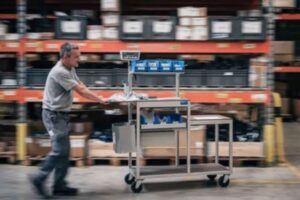
Au centre de cette stratégie, on retrouve le concept de Goods-to-Man (le produit vers l’homme). Plutôt que de voir un préparateur parcourir 15 kilomètres par jour pour préparer ses commandes, c’est le stock qui vient à lui.
Robots AMR vs AGV : Faire le bon choix pour vos flux
Pour réussir cette transition vers le Goods-to-Man, il vous faut d’abord comprendre vos « joueurs » et les technologies en jeu. En effet, le choix entre robots AGV et robots AMR va déterminer votre flexibilité.
- Les AGV (Automated Guided Vehicles) : Ils suivent des parcours prédéfinis (filoguidage, bandes magnétiques). Ils sont parfaits pour des flux répétitifs et massifs de palettisation ou de transport de charges lourdes entre deux points fixes. Cependant, ils manquent de souplesse si l’aménagement de l’entrepôt change.
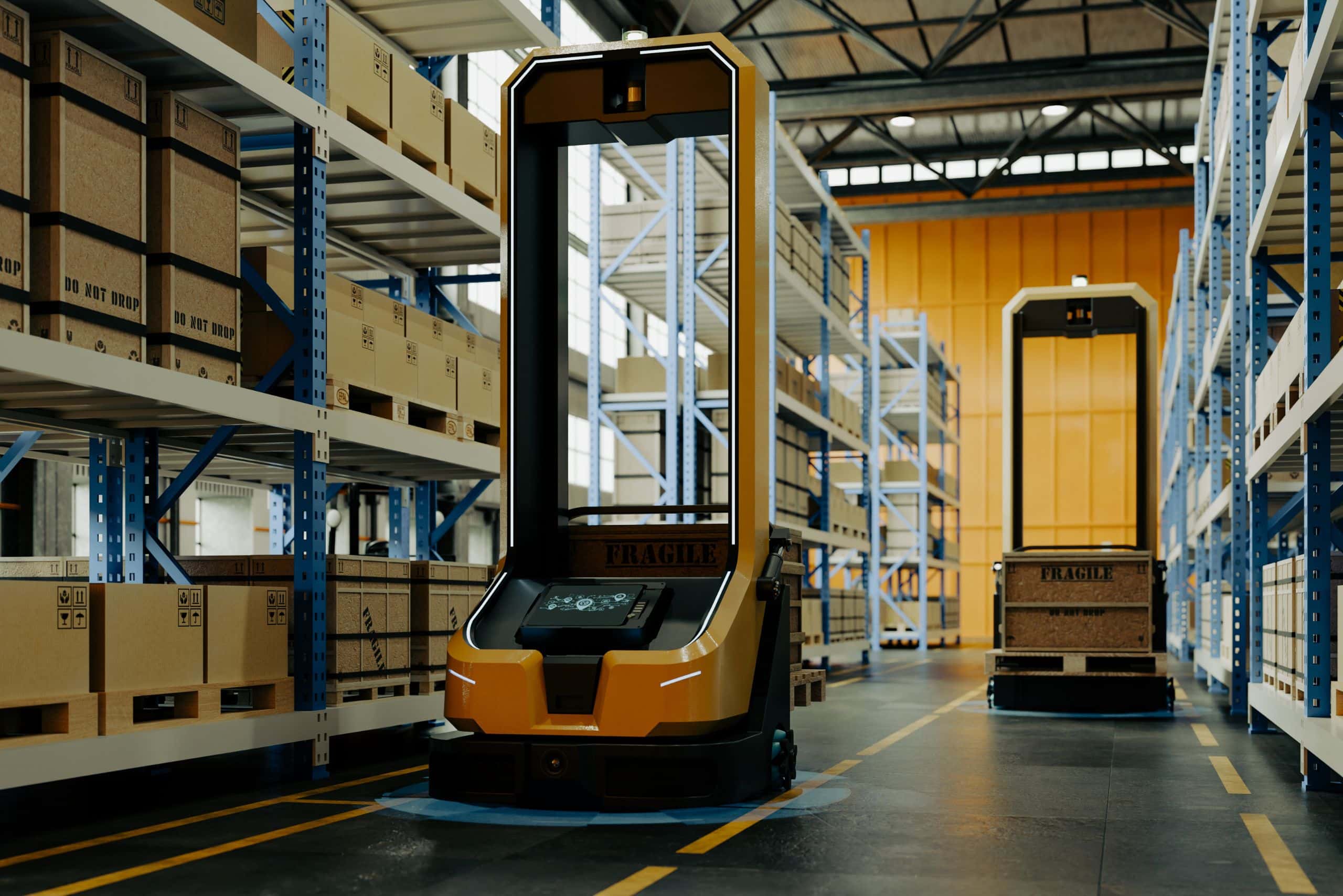
- Les AMR (Autonomous Mobile Robots) : Ce sont les véritables champions de la modularité. Grâce à des capteurs et une intelligence embarquée, ils naviguent de manière autonome, évitent les obstacles et recalculent leur itinéraire en temps réel. Ils sont les alliés parfaits pour le picking dynamique.
L’utilisation de robots mobiles permet d’ajuster la flotte en fonction des besoins.
L’avantage ? Vous pouvez commencer avec trois robots et en louer dix de plus pour les pics d’activité de fin d’année. C’est la définition même de la scalabilité opérationnelle.
Focus sur AutoStore et Exotec : La densité au service de la performance
Des systèmes comme AutoStore ou le système Skypod d’Exotec illustrent parfaitement cette modularité. Le stockage n’est plus linéaire mais cubique.
- Densité extrême : Vous réduisez votre empreinte au sol jusqu’à 75% grâce à l’utilisation de grilles.
- Scalabilité indépendante : Vous avez besoin de plus de stocks ? Ajoutez des bacs et de la grille. Vous avez besoin de plus de vitesse ? Ajoutez des robots sur la grille existante.
Cette flexibilité est totalement impensable avec des systèmes de transstockeurs classiques.
- Analyser la typologie de vos SKU : sont-ils compatibles avec des bacs standards ?
- Mesurer la distance moyenne parcourue par vos préparateurs de commandes.
- Identifier vos goulets d’étranglement lors des pics d’activité.
- Vérifier la solidité et la planéité de votre sol (les robots mobiles vous remercieront).
- Comparer le coût de l’extension de votre entrepôt vs la densification par le stockage cubique.
Le pilotage intelligent : Quand le WMS rencontre le WCS
L’automatisation sans intelligence logicielle n’est que de la « ferraille » intelligente. Pour que vos robots amr et vos stations de packing fonctionnent en harmonie, vous avez besoin d’une architecture logicielle robuste.
Le Warehouse Management System (WMS) : Le stratège
Le logiciel de gestion d’entrepôt (WMS) détient la vision globale. C’est lui qui possède la connaissance du stock, gère la gestion des inventaires, l’ordonnancement des commandes, le slotting (l’emplacement optimal des produits) et pilote la gestion des retours.
Petit plus : Un logiciel WMS en SaaS offre aujourd’hui une connectivité accrue via des API. Il permet une traçabilité en temps réel sur l’ensemble de la supply chain, depuis la réception de marchandise jusqu’à l’expédition.
Le Warehouse Control System (WCS) : Les muscles de l’exécution
Le WCS est l’interface qui parle directement aux machines et est le garant de la performance 4.0. Il reçoit les ordres du WMS (« J’ai besoin de cet article ») et les traduit en instructions actionnables pour les solutions automatisées.
Pourquoi est-ce vital ? Parce que les systèmes comme Exotec ou AutoStore fonctionnent souvent comme des « boîtes noires ». Le WMS envoie une commande, et le WCS gère l’optimisation interne des mouvements des robots pour sortir le bon bac au bon moment. Une intégration fluide entre votre solution WMS et le WCS évite les goulots d’étranglement et garantit une rotation de stock fluide.
Optimisation opérationnelle : La science du détail
Automatiser ne signifie pas simplement remplacer des bras par des moteurs. C’est repenser l’organisation du travail pour maximiser la valeur ajoutée humaine.
Le slotting dynamique et le classement ABC
Grâce à l’intelligence de votre logiciel de gestion de stock, vous pouvez mettre en place un slotting dynamique. Le système analyse en continu les ventes et demande aux robots de déplacer les articles les plus demandés (Classe A) vers les zones les plus proches des stations de picking. Cette réorganisation se fait souvent « en temps masqué » durant les heures creuses, préparant ainsi l’entrepôt pour le prochain pic d’activité.
Poka Yoke pour un zéro défaut
Le poka yoke (terme japonais pour « détrompeur ») est particulièrement efficace dans les systèmes Goods-to-Man. Par exemple, afin d’éviter les erreurs de picking, la station de travail peut guider le préparateur grâce à un faisceau lumineux (Pick-to-Light). Ce dernier indique visuellement quels produits doivent être prélevés et en quelle quantité. Résultat ? Un taux d’erreur proche de zéro, ce qui réduit drastiquement les coûts liés à la gestion des retours.
Co-packing et cross-docking : gagner en agilité
L’automatisation libère du temps pour des tâches plus complexes comme le cross-docking et le co-packing (personnalisation des colis). Les marchandises arrivant en zone de réception peuvent être directement injectées dans le système pour repartir le jour même, sans passer par la case « stockage ». De même, le temps libéré par les robots permet à vos équipes de se concentrer sur des tâches à forte valeur ajoutée comme le co-packing (création de kits ou d’offres promotionnelles).
Analyse de flexibilité : Automatisation modulaire vs Systèmes rigides
Pourquoi devriez-vous privilégier la modularité plutôt qu’un système de convoyage traditionnel ? La réponse est simple : la rigidité est l’ennemie du ROI (Retour sur Investissement) à long terme.
- Installation et mise en service : Un système de convoyeurs nécessite des travaux de génie civil lourds et immobilise l’entrepôt pendant un certain temps. Un système modulaire comme les robots mobiles peut être déployé par zones, sans arrêter l’activité globale.
- Adaptabilité des flux : Si votre business modèle passe du B2B au B2C, vos besoins de picking changent radicalement (de la palette au colis individuel). Un système modulaire s’adapte en ajustant simplement le partitionnement des bacs.
- Évolutivité financière : Vous payez pour ce que vous utilisez. C’est l’essence même de la logique SaaS appliquée au matériel.
Un dernier conseil : Avez-vous calculé le coût d’une ligne de convoyage à l’arrêt pour maintenance ? Eh oui, dans un système modulaire, si un robot tombe en panne, les autres continuent le travail.
Étapes pour une transition réussie vers l'automatisation modulaire
Vous êtes convaincu par les bénéfices. Mais par où commencer ? Ayez en tête que l’automatisation est un voyage, pas une destination.
1. Analyse des données et anticipation du futur
Tout commence par une analyse fine de vos données. Quelle est la volumétrie de vos SKU ? Quelle est votre saisonnalité ? Aussi, votre cahier des charges doit intégrer vos ambitions de croissance à 3 et 5 ans pour choisir une solution WMS capable de supporter l’évolution technique.
2. Préparer les équipes au changement
L’humain doit rester au centre. L’arrivée de systèmes automatisés peut générer de l’appréhension. Communiquez sur la réduction de la pénibilité (moins de marche, moins de port de charges) et sur la montée en compétences (pilotage de systèmes, maintenance de premier niveau).
Rentabilité et ROI : Le calcul de la performance
Parlons chiffres. Oui, l’automatisation modulaire représente un investissement, mais son ROI est souvent plus rapide qu’on ne le pense ; souvent entre 3 et 5 ans.
- Réduction des coûts de main-d’œuvre : En multipliant par 3 ou 4 la productivité au picking, le besoin en personnel sur les tâches répétitives diminue.
- Optimisation de l’espace : En densifiant le stockage, vous évitez ou repoussez l’agrandissement de votre bâtiment ou la location d’un entrepôt supplémentaire.
- Diminution des erreurs : Le coût d’une erreur de préparation (réexpédition, mécontentement client, gestion du stock faussée) est estimé entre 30 et 50 euros par commande. Multipliez cela par votre volume annuel, et le calcul est vite fait
L’automatisation modulaire : Une stratégie plus qu’une technologie
L’automatisation modulaire n’est pas une tendance, mais une réponse structurelle aux mutations profondes de la logistique. En privilégiant des solutions Goods-to-Man flexibles, pilotées par un logiciel de gestion d’entrepôt adapté, vous transformez votre entrepôt en un moteur de croissance agile.
Le secret de la réussite réside dans le choix d’un partenaire capable de comprendre votre métier, et non d’un simple vendeur de machines. Votre logiciel de traçabilité logistique et votre infrastructure physique doivent ne faire qu’un pour répondre aux promesses faites à vos clients.
Vous souhaitez auditer vos flux pour identifier vos opportunités d’automatisation ?
Contactez nos experts pour une analyse personnalisée et découvrez comment notre solution WMS EGO peut devenir le socle de votre transformation logistique.
FAQ : Tout ce qu’il faut savoir sur l’automatisation modulaire
Quelle est la différence entre mécanisation et automatisation ?
La mécanisation des entrepôts utilise des machines pour aider l’humain (convoyeurs, filmeuses). L’automatisation va plus loin en confiant le pilotage et l’exécution de la tâche à un système autonome dirigé par un logiciel de gestion d’entrepôt.
L’automatisation modulaire est-elle réservée aux grandes entreprises ?
Absolument pas. C’est tout l’intérêt de la modularité. Des solutions peuvent être déployées sur de petites surfaces avec seulement quelques robots mobiles.
Combien de temps faut-il pour installer un système type AutoStore ou Exotec ?
L’installation physique peut prendre de quelques semaines à quelques mois selon la taille de la grille. Cependant, l’avantage est que l’on peut construire la structure pendant que l’entrepôt continue de fonctionner à côté.
Un logiciel WMS est-il obligatoire pour piloter des robots ?
Oui, c’est indispensable. Le logiciel WMS gère l’intelligence métier (quelles commandes prioriser, quelle rotation de stock appliquer). Sans lui, les robots ne sauraient pas quoi aller chercher. Le couple WMS/WCS est le garant de votre efficacité.
Comment gérer les pics d’activité avec un système automatisé ?
Dans un système modulaire, vous pouvez soit ajouter des robots (scalabilité matérielle), soit optimiser vos flux en amont grâce au slotting dynamique. Certains fournisseurs proposent même la location de robots supplémentaires pour les périodes de forte activité.
Est-ce compatible avec des produits de tailles différentes ?
Les systèmes Goods-to-Man utilisent des bacs standardisés. Cependant, il est possible de compartimenter ces bacs pour stocker différents SKU de petite taille, ou d’utiliser des robots AMR capables de transporter des étagères entières pour des produits plus volumineux.