

















Jumeau numérique et modélisation 3D : Comment ces technologies révolutionnent votre entrepôt ?
WMS software
Logistics
4.0 solutions
Supply Chain
December 12, 2025
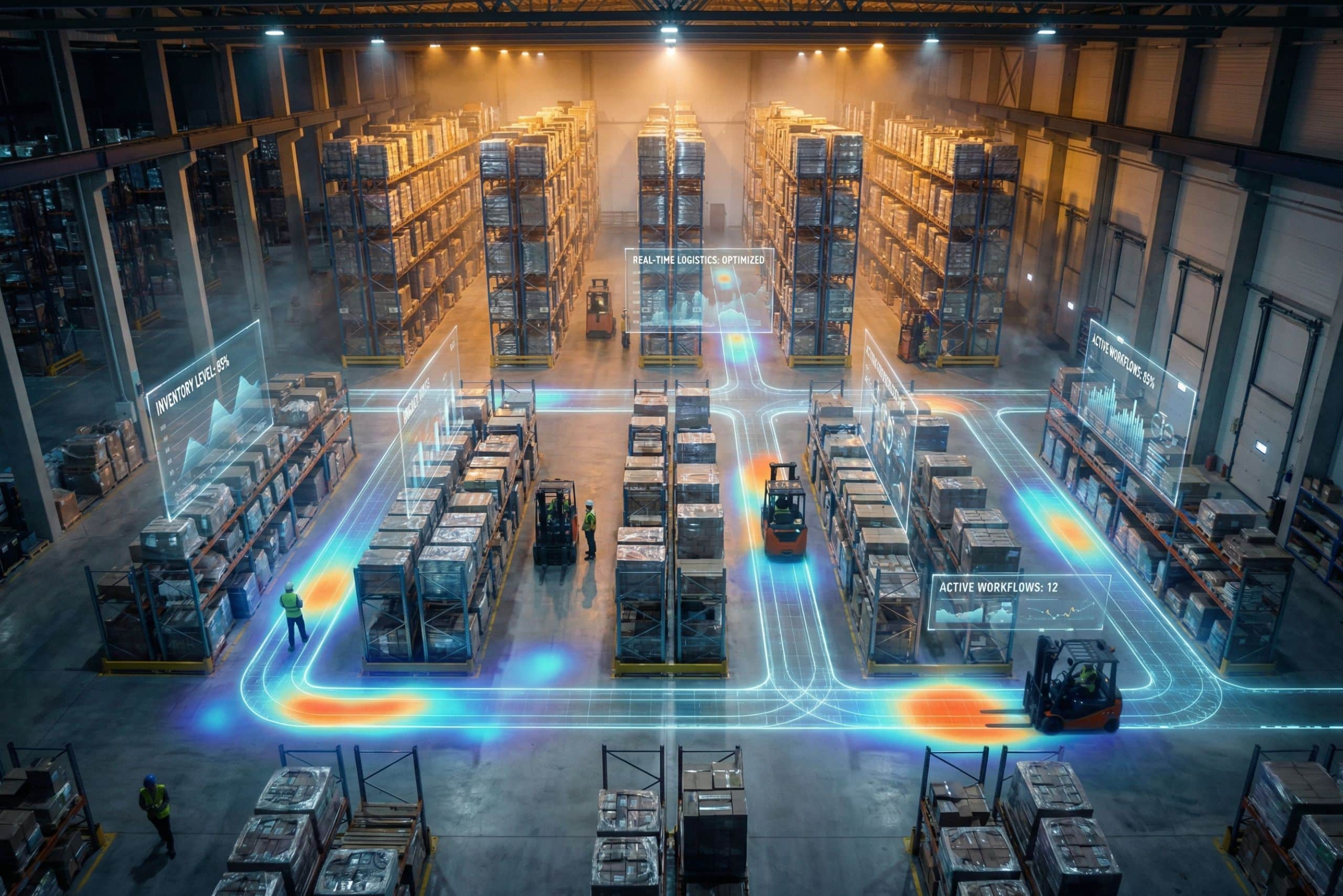
Imagine being able to test a major change to your logistics platform before even moving a single pallet. Visualize the impact of a sudden surge in activity or the integration of new AGV robots without disrupting your ongoing operations.
This is precisely the promise, now fulfilled, of 3D modeling and especially of the digital twin of the warehouse. This technology is no longer a science fiction concept, but a strategic tool for anyone seeking to excel in logistics.
Why is this a topic in 2026?
Companies that adopt this advanced simulation approach radically transform their logistics flow, moving from reactive management to proactive and predictive inventory management.
The question is not whether you should consider the digital twin, but rather how you can quickly integrate it to gain a decisive competitive advantage.
From 3D model to digital twin: What's the difference for the warehouse?
Although often confused, simple 3D modeling and digital twin represent two distinct steps in the digitalization of the supply chain.
Static 3D modeling
Initially, 3D modeling creates a faithful and static visual representation of your warehouse. It's the equivalent of a detailed plan or a virtual model. It allows you to visualize the layout, the location of racks, loading docks, and order picking areas.
The dynamic digital twin
The digital twin goes much further. It's a virtual replica , but this time dynamic and intelligent , of your physical warehouse, capable of synchronizing in real time with operational data. It doesn't just show your warehouse; it understands and simulates .
- Real-time synchronization: It is constantly fed by real data.
- Dynamic behavior: It models the movement of operators, carts, AGV or AMR robots, and the evolution of stocks (SKU) and stock turnover.
- Predictive capability: It is a true laboratory for testing "What if..." scenarios without risking real activity.
It is this dynamic and intelligent aspect that makes it so valuable for optimizing logistics.
How to create and populate a digital twin with data from your WMS and IoT?
The strength of a digital twin lies in the quality and continuity of the data that feeds it. It acts as a central hub , integrating information from all the components of your logistics information system.
Integrating the core of logistics: The WMS
Your WMS ( Warehouse Management System ) software is the backbone of the digital twin. It provides essential data on:
- Inventory management (quantity, location, SKU status).
- Order status (in progress, prepared, shipped).
- The movements and tasks assigned to operators and equipment.
- Key performance indicators (KPIs) such as service rate or picking cycle .
Warehouse management software , or a WMS solution, is therefore a prerequisite. Advanced location management features in WMS
The physical and connected dimension: IoT and automation
robots and AMR robots , as well as conveyor and palletizing systems, are equipped with sensors designed to generate a constant stream of data. Similarly, IoT (Internet of Things) devices installed on carts, racks, or, in some cases, on operators (wearables) transmit information such as:
- Real-time tracking of the location of goods and equipment.
- Machine performance and status data ( warehouse mechanization ).
- Temperature, humidity, or any other environmental factor.
This raw data is used to accurately model the physical behavior of the warehouse. Then, your WMS will ensure that every movement is recorded and replicated in the digital twin.
Intelligence at the service of simulation: Generative AI
Integrating generative AI goes beyond simple warehouse replication. AI can analyze millions of data points, identify hidden correlations, and generate realistic business scenarios (including unforeseen events and activity spikes). This allows the virtual twin to predict bottlenecks and inefficiencies.
Actionable checklist: Powering your digital twin
- Auditing WMS data: Ensure that your WMS solution comprehensively records the cycle times of each process (receiving goods, picking, packing).
- Identify IoT sources: List all data collection points: sensors on AGVs, mobile scanners, sorting systems.
- Standardize data: Implement protocols so that WMS and IoT data are in a single format usable by the digital twin.
- Ensuring latency: Opt for a WMS platform and IoT solutions that guarantee data updates with minimal latency, especially for traceability.
Practical uses: Testing a new layout, simulating activity spikes, or adding a new machine
The true return on investment of a digital twin is manifested in its concrete applications, which allow for risk-free optimization and informed decision-making.
Example 1: Optimizing the layout and slotting
Have you ever hesitated to redesign an area of the warehouse for fear of disruption? The digital twin completely eliminates this uncertainty.
- Testing new layouts: Simulate the impact of relocating a cross-docking area , reorganizing aisles, or integrating a new sorting system. Observe the effect on distances traveled and picking productivity.
- Refine slotting: dynamic slotting strategies based on the ABC method or seasonal changes. The twin can predict the best location for each SKU to minimize travel time.
- Reduce costs: According to Deloitte, optimizing layout and slotting through simulation can reduce warehouse labor costs by 10 to 20% (Source: Deloitte, The Digital Supply Network ).
Example 2: Preparing for peak activity
Peak periods of activity (Black Friday, Christmas, sales) can be stressful if not anticipated. A digital twin allows you to approach them with confidence.
- Simulate the load: Inject an exceptional volume of orders (e.g., 50% more than the historical maximum) into the twin.
- Resource assessment: The model instantly reveals whether current resources (operators, forklifts, palletizing area capacity, etc.) are sufficient. It can even determine the exact number of temporary workers required and the optimal team layout to avoid bottlenecks.
- Process validation: Test the robustness of your co-packing or cross-docking process under intense pressure.
Example 3: Integration of automation and mechanization
Investing in warehouse automation shuttle systems , conveyors) can be enormous. A digital twin acts as insurance before a potential purchase.
- Equipment evaluation: Before purchasing, model the addition of robots or an automated packing machine. Determine the most suitable model and the precise return on investment point.
- Process validation: Ensure that adding new technology does not create a bottleneck elsewhere (domino effect). For example, a faster picking speed should not saturate the loading dock .
- The Poka Yoke principle: The digital twin allows the integration of error detection mechanisms by simulating failure scenarios to strengthen the reliability of processes.
Example 4: Returns management (reverse logistics)
Returns logistics is a constant challenge, especially in e-commerce.
- Modeling the reverse flow: Create a model to simulate the impact of a high return rate.
- Optimizing the returns area: Determine the layout and resources needed for efficient returns management, minimizing restocking time and impact on the main logistics flow.
Towards the autonomous warehouse: When the digital twin directly controls operations
The pinnacle of this technology is the autonomous warehouse, where the digital twin does not just simulate; it makes real-time decisions and executes them.
From simulation to prescription
Thanks to traceability and AI algorithms, the digital twin can constantly compare the current performance of the warehouse to its simulated optimal performance.
- Alert and correction: If the twin detects a deviation (for example, a slowdown in picking or congestion on a delivery dock), it immediately alerts or, in the most advanced systems, takes corrective action.
- Task redistribution: The twin can recalculate the best route for AMR robots in real time, for example, or dynamically reassign tasks to operators to decongest an area. This is an advanced form of orchestration made possible by deep integration with the WMS software.
The strategic role of TMS and the last mile
The impact of the digital twin extends beyond the warehouse walls, encompassing the supply chain.
- TMS Integration: The digital twin can connect to TMS ( Transport Management System ) software. By simulating real-time order preparation, it informs the logistics TMS of the exact time batches are available, allowing for optimization of the loading plan and last-mile .
- Green logistics: By simulating the energy efficiency of different configurations (lighting, heating, trolley consumption), the digital twin contributes to more virtuous logistics and helps the company to achieve its CSR objectives.
Actionable checklist: Implementing autonomous piloting
- Ensure reliable data integration: Ensure that information flows between the WMS, automation systems and the twin are bidirectional and instantaneous.
- Define decision rules: Clearly establish the thresholds and rules under which the twin has the authority to make automatic decisions (e.g., "If the wait at picking exceeds 5 minutes, reassign 2 operators from the co-packing area").
- Test in "Advisor" mode: Start by using the twin in prescriptive (it proposes actions, the human validates) before moving to autonomous mode.
- Training and maintenance: This is a system that can be complex. It requires team training and continuous maintenance to reach its full potential.
Choosing the right solution: Criteria for your WMS and digital twin specifications
Adopting this technology requires choosing a WMS solution compatible with 3D modeling. Therefore, several criteria are essential when drafting your WMS specifications:
- Openness and API: The solution must have open APIs to facilitate the integration of IoT data and external systems.
- Quality of modeling: The ability to model not only infrastructure, but also human and robotic behavior, including the management of unforeseen events.
- AI/ML support: Check for the presence of machine learning modules to optimize dynamic slotting and predict resource requirements.
- Cost and scalability: The price of the WMS must be justified by the scalability of the solution, often offered by a SaaS solution which allows for resource adjustment.
From reactive management to predictive control: Master the future of your logistics
The digital warehouse twin, powered by WMS software, IoT data, and artificial intelligence, is much more than a trend today; it's part of the strategy for managing the complexities of logistics flows. Indeed, it offers comprehensive visibility, unprecedented optimization of inventory management , and a significant reduction in the risks associated with heavy investments in warehouse automation.
By allowing you to test each scenario (from goods receipt to final palletization) in a virtual environment, you transform your warehouse. From a cost center, it becomes a true engine of growth, capable of managing market fluctuations, technological innovations, and ensuring impeccable traceability.
Ready to transform your warehouse into a laboratory of excellence?
Act now and contact us to assess the compatibility of your current warehouse management software with the requirements of a digital twin.
FAQ: Everything you need to know about the warehouse digital twin
What is the difference between classical logistics simulation and digital twin?
Traditional simulation uses historical or hypothetical data to model scenarios. A digital twin, on the other hand, is a dynamic replica that uses real-time data from your WMS software, IoT, and automation systems. It lives and breathes in sync with your physical warehouse, enabling continuous, not just one-off, optimization.
What ROI can be expected?
- 20 to 30% increase in productivity
- 25% reduction in errors
- 10 to 50% less risk in logistics projects
What role does dynamic slotting play in the digital twin?
Dynamic slotting (the continuous adjustment of SKU placement based on demand and inventory turnover) is a feature that greatly benefits from the digital twin. The twin simulates the impact of placement changes in real time, ensuring that WMS recommendations are optimal for peak activity or seasonal fluctuations.
How does the digital twin help with returns management?
By modeling the reverse logistics flow, the twin allows for the sizing of the returns logistics area and the necessary resources. It can simulate a high return rate and test different product reintegration strategies (inspection, repackaging, restocking) to minimize the impact on the main flow and optimize returns management.
Can a digital twin be integrated into a TMS for the last few kilometers?
Absolutely. The twin guarantees the exact time of completion of order preparation for loading, allowing the TMS to optimize the transport plan and the routing of the last few miles, thus ensuring better delivery punctuality.
Most read articles
WMS software
Logistics
Supply Chain
July 3, 2024
Inventory management using WMS software
To master your inventory management, it is imperative to use suitable and efficient inventory management software. With this automation, you can monitor the status of your inventory in real time, allowing you to make informed and rapid decisions to avoid stock-outs or overstocks.
Logistics
Supply Chain
June 10, 2024
Reverse logistics: our management of product returns
Reverse logistics, or reverse logistics, is a management process that focuses on returning products from the consumer to the manufacturer or distributor.
WMS software
Logistics
September 20, 2024
How much does a WMS cost?
The price of a WMS (Warehouse Management System) can vary considerably, ranging from €25,000 to €250,000 (or more) for its acquisition. The cost of WMS software depends on many factors, including the required features, the size of the warehouse, and the complexity of logistics operations.